Available PhD Topics
Below you will find information about available PhD projects.
Please note: PhD topics listed on our website are currently not all final. We expect to have them all updated by mid-September. However, updated topics are usually in the same science areas as those already listed.
Please select your topic of interest:

MPE Infrared Astronomy: Galaxy Evolution, Galactic Nuclei, and Black Holes
We take a unique approach in combining experimental and observational astrophysics - we focus on important astrophysical questions, and then build the best instruments to answer them! Our main science themes center on the formation and evolution of galaxies at redshifts between 1 and 3, and the physics of galactic nuclei and black holes across cosmic time. Key results have been the unambiguous detection of the supermassive black hole in the center of our Galaxy through stellar orbits and the first successful test of  General Relativity in the vicinity of a supermassive black hole, the first substantial survey of high redshift galaxy dynamics using integral field spectroscopy, and the first studies of cold gas and far-infrared luminosities of distant massive 'normal' galaxies.
These results show samples of our research on the physics and growth of black holes in galactic nuclei, especially the Galactic Center; gas dynamics in the vicinity of SMBHs; the nature and evolution of star forming galaxies at low and high redshift; and feedback processes from star formation and AGN. Within our own Galaxy, our research focusses on the physical and chemical evolution of dense gas associated with protostars and protoplanetary disks, with special emphasis on the role of water.
A key strength is that we lead world-class instrumentation developments that are driven by our astrophysical research. In the near-infrared, we have been the PIs or significantly contributed to several current instruments at the ESO VLT over the last 2 decades: SINFONI, the integral field imaging spectrometer, NACO, the diffraction limited imager, and the KMOS multi-IFU spectrograph. We were the PI Institute for the far-infrared camera/spectrometer PACS operating from 2009 to 2013 on board ESA's Herschel Space Observatory.
Currently, we are the PI-group for GRAVITY, an astrometric imager and the first second-generation instrument for the VLT interferometer. GRAVITY is now in full operation, and is a game changer for infrared interferometry, because it can routinely observe sources up to a factor 1000 more sensitive than previous interferometers. We are building GRAVITY+ which will provide further drastic improvements of sensitivity and sky coverage. Spectacular results from our team include testing General Relativity near the Galactic Center black hole, and kinematically resolving the broad line region in nearby and distant AGN and QSOs, among other topics.
We are also the PI institute for the ERIS diffraction limited imager and spectrograph at the VLT, which is now executing our major galaxy evolution and Galactic Center observing programmes, and the first-light instrument, MICADO, for the upcoming European Extremely Large Telescope. At longer wavelengths members of our group have actively supported the upgrade of NOEMA at IRAM.
Research areas for which we offer PhD theses are:
- Galaxies and black holes in the first few billion years with JWST/NIRSpec
- Unique instrumentation concepts in high resolution astronomy – MICADO, GRAVITY+
- Exploring galaxy evolution through near-infrared to mm-wave high resolution observations of high redshift galaxies – NOEMA3D/ERIS
- The Black Hole in the center of our Galaxy and its surrounding stellar cluster with GRAVITY and ERIS – a laboratory for understanding black holes and strong gravity –
- Accreting black holes: resolving the broad line region and host dust distribution in active galactic nuclei GRAVITY-AGN
For more details visit the homepage MPE Infrared-Astronomy.

High resolution studies of galaxy evolution like the surprising detection of a massive rotating disk in the z=2.38 galaxy BzK-15504 are made possible by our active instrumentation program, for example the PARSEC laser at the ESO VLT.
MPE High Energy Astrophysics
High Energy Astrophysics addresses among the most extreme processes and regions in the Universe. Plasma with temperatures up to billions of degrees, and the interaction of highly energetic electrons with magnetic and photon fields generates high energy radiation in the X-rays and gamma rays. Studying cosmic objects in these wavebands gives insights into physical processes that often cannot be achieved when observing in other wave bands.
The High Energy Astrophysics group at MPE, comprising about 80 members, has its major scientific emphasis on the study of these processes, mostly via X-ray observations, but also extending to other wavebands. Our main astrophysical themes are: 1) Investigating physical processes including strong gravity around black holes and other compact objects; 2.) The cosmic history of black hole growth and its relationship to galaxy evolution; 3) Large scale structure, as probed hot gas in clusters and groups of galaxies, and the related cosmological implications; 4) gamma-ray bursts.
To achieve our scientific aims the group runs a major experimental program in the development and construction of X-ray instrumentation. We also develop highly specialized X-ray detectors, which including the EPIC pn-CCD camera on XMM-Newton and the eROSITA pn-CCD cameras. We are currently developing the technologies for the Athena Wide Field Imager (WFI) instrument.
We have long experience in the realization of X-ray telescopes, while whole satellite payloads are calibrated in our 130 m test facility PANTER. This engagement enabled us to build and operate for over 8 years the ROSAT observatory, and collaborate actively in all major X-ray observatory missions, especially XMM-Newton and Chandra.
The high energy group successfully launched the X-ray observatory eROSITA on July 13, 2019. The observatory is currently on the Langrangian point L2 where four of the eight planned full-sky surveys has been performed. An Early Data Release (EDR) took place in the Summer 2021. The release covers the data acquired in the performance verification phase and includes the observation of contiguous 140 square degrees of the so called eFEDS area, which was observed at the final depth that eRASS:8 will have in average, at the end of the mission. We are preparing for the first Data Release of eRASS:1, the first pass of the entire sky of the German Hemisphere. The eROSITA X-ray all-sky survey will be a factor of 10-30 deeper than the ROSAT all-sky survey performed in the early 90s. Using optical, infrared and radio data to better interpret the X-ray results has also stimulated working in a worldwide net of astronomy collaborations.
Research fields for which PhD projects are offered include:
- X-ray observations of strong gravity effects in active galactic nuclei and X-ray binaries
- Black hole growth through cosmic time and its relation to galaxy evolution
- Searches for accreting black holes in the early Universe
- Large-scale structure and cosmology via X-ray studies of clusters and groups of galaxies and the intergalactic medium
- Black hole growth through cosmic time and its relation to galaxy evolution
- Accretion physics and strong gravity effects in active galactic nuclei and X-ray binaries
- High energy transient phenomena such as gamma-ray bursts, tidal disruption events and quasi-periodic eruptions
- Galactic scale hot gas emission e.g. from supernova remnants, the eROSITA bubbles and the circumgalactic medium
Please click here for more details about the group.
Please click here for more details on the available IMPRS projects.

Left: eROSITA instrument during the qualification tests. Right: Planned eROSITA “cadence” map. The celestial sphere in equatorial coordinates is color-coded by the number of visits of eROSITA during the 4-years all-sky survey. The eROSITA all-sky survey is expected to provide insight on 3 million AGN and 100000 clusters.
MPE Optical and Interpretative Astronomy &
LMU/USM Extragalactic Astronomy
The LMU/USM - MPE extragalactic research group is a joint effort of the University Observatory of Munich (USM) and the Max Planck Institute for Extraterrestical Physics. The group is located both at the LMU/USM (see 'Extragalactic Astronomy') and at MPE. Senior group members are Prof. Ralf Bender, Dr. Maximilian Fabricius, Prof. O. Gerhard, Dr. Ulrich Hopp, P.D. Dr. Roberto P. Saglia, Dr. Ariel G. Sánchez, Dr. Stella Seitz and Dr. Jens Thomas.
The research of the group focuses on dark energy and dark matter in the Universe, on the properties of local and distant galaxies, and on extrasolar planets. The aims of our current science projects are:
- to constrain the nature of dark matter, by analysing cluster and galaxy dark matter halo profiles with strong and weak lensing in combination with dynamical and photometric information for nearby galaxies
- to derive constraints on the nature of dark energy, by studying the large-scale structure of the Universe by means of weak lensing and clustering measurements
- to understand the structure and dynamics of local and distant galaxies, their stellar populations, their formation and evolution
- to reconstruct the dark matter mass distribution and chemodynamical history of the Milky Way from the current revolutionary survey data, giving us a template for galaxy formation
- to quantify the role of black holes and dark matter in galaxies
- to search for extrasolar planets using the transit method in wide field surveys and understand their properties (mass, density, atmosphere)
We pursue these science questions with a combination of optical and near-infrared observations, theory, numerical modelling, and data interpretation.
The observational data necessary for our scientific programs come from a large variety of telescopes, primarily ESO, the Hobby-Eberly Telescope HET, the 2.7m telescope of the McDonald observatory, the USM 2m Fraunhofer telescope at the Wendelstein observatory in the Bavarian Alps and also space (HST) and survey (e.g. SDSS) telescopes. We also have guaranteed access to telescopes for providing instruments (e.g.OmegaCAM, KMOS,
MICADO).
We carry out studies of black holes in local galaxies without active galactic nuclei, measuring their masses through stellar dynamics. Using similar techniques we reconstruct the stellar orbital distributions and dark matter halos of dwarf and giant early-type galaxies or globular clusters. Exploiting the multiplexing capabilities of our KMOS spectrograph, we study galaxy evolution up to redshift 2.5 by observing large samples of star forming and passive galaxies.
Our group also participates with a significant role in large international surveys. Examples are the completed Baryon Oscillation Spectroscopic Survey BOSS, the on-going extended BOSS
(eBOSS) and Dark Energy Survey (DES), and future surveys such as the Hobby-Eberly Telescope Dark Energy Experiment (HETDEX) and the ESA space mission Euclid. Galaxy clustering and gravitational lensing measurements based on these data sets probe the large-scale structure of the universe with unprecedented precision, providing invaluable information on the nature of dark matter and dark energy, the growth of structure, neutrino masses and inflationary physics. The design, construction, analysis, modelling and interpretation of these data sets are some of the main activities of our group.
The numerical modelling required for our projects is based on state-of-the-art algorithms run on supercomputers. Some of these methods are developed or implemented within our group. Recent examples are Schwarzschild's orbit superposition method used for measuring black hole masses, and the NMAGIC adaptive N-body code for modelling galaxy dynamics.
This year we offer PhD projects within our group in the following science areas:
- Gravitational lensing
- Dynamical modelling galaxies
- Stellar content and structure of the Milky Way
- Cosmological analysis of galaxy clustering measurements
- Instrument development
For more details visit our homepages OPINAS or PhD-Thesis Projects.
MPE Center for Astrochemical Studies
We are an interactive group of observers, theoreticians and laboratory experimental
researchers, with strong links to other national and international Institutes. Our aim
is to study interstellar clouds and their physical/chemical evolution toward the formation
of stars and planetary systems. On the one hand, molecular lines are used as tools to
unveil the physical structure and dynamics of clouds and star/planet forming regions.
On the other hand, observational and theoretical studies of molecules during cloud
evolution allow us to investigate the increase in chemical complexity from the initial
diffuse stages, to the dense cloud cores within which stellar systems form, to the
circumstellar disks where planets are assembled, with the final aim of shedding light
on our cosmic origins (cf. the Figure at the end of this section). We observe molecular lines with state-of-the-art
telescopes (such as ALMA and the
IRAM Plateau de Bure Interferometer / NOEMA) and we make predictions using comprehensive chemical models inclusive of surface
chemistry (i.e. the chemistry occurring on the surface of dust grain particles). Furthermore, we use magneto- and hydrodynamic codes coupled with simple chemistry, and apply advanced theoretical methods of the kinetic theory and plasma physics to understand penetration of Galactic cosmic rays into dense molecular gas.
The CAS spectroscopy laboratories focus on the high-resolution spectroscopy of molecules of astrophysical relevance in the gas and solid phase (i.e. interstellar ice analogs), as well as on collisional dynamics and ion-molecule interactions. Laboratory experiments provide a fundamental input to our
observational and theoretical activities, as transition frequencies are measured
with high precision and the molecular structure determined.
We offer PhD thesis in the following areas:
- Theory: Cosmic rays in molecular clouds.
- Laboratory: The path to molecular complexity in star-forming regions - a laboratory approach
For current PhD projects offered, please follow this link.
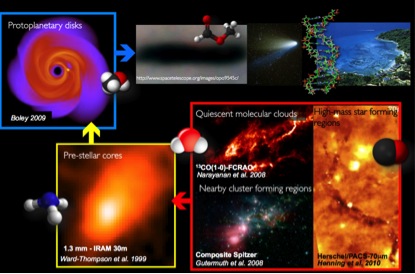
Our cosmic origins: Schematic illustration of the various phases in the process of star
and planet formation, which are studied in the CAS group (from parsec-scale molecular
clouds in the bottom right, to the 10,000 AU-scale of pre-stellar cores, to the 100
AU-scale of protoplanetary disks in various stages of evolution, to our Solar System).
The five superposed molecules (anticlockwise from the bottom right: CO, H2O, NH3, CH3OH,
HCOOCH3) are among the most common molecules observed in star forming regions. They are
only five out of the about 180 (mostly organic) molecules detected in space. Interstellar
molecules are the building blocks of more complex organics also found in meteorites, such
as amino acids, purine and pyrimidine bases and sugars, i.e. the basic building blocks of
proteins and nucleic acids (such as the deoxyribonucleic acid, DNA, in the top right)
present in living beings on Earth (see Caselli & Ceccarelli 2012;
Ceccarelli et al. 2014 for more details).
LMU/USM Computational Astrophysics
The research of the computational astrophysics group at the USM is focussed on dynamical processes in galaxies, related to galaxy formation and evolution, the evolution of the interstellar medium and star and planet formation. Using different numerical methods and codes, coupled with special hardware connected to local PC clusters for fast computations we explore the complex non-linear evolution of gas in galaxies and its condensation into dense molecular clouds and stars. We explore the collapse of protostellar clumps and cores, the formation of protostellar disks and their condensation into planets. On larger scales we investigate galaxy-galaxy interactions including dark matter, stars and gas and study the morphological transitions of galaxies and the origin of their spheroidal components.
Research fields for which PhD projects are offered:
- Origin of very old, massive elliptical galaxies
- The cosmological angular momentum problem
- The origin of turbulence in the interstellar medium
- Formation of clumpy, turbulent molecular clouds
- Formation of stellar clusters and disruption of molecular clouds
- Origin and evolution of stellar disks around massive black holes in the centers of galaxies
- Evolution of protoplanetary disks and their condensation into brown dwarfs and massive planets
For more details visit the homepage USM Computational Astrophysics.
LMU/USM Theoretical Astrophysics of Extrasolar Planets
The Chair of Theoretical Astrophysics of Extrasolar Planets at LMU performs research on exoplanet science beyond theory and simulation. It includes observations and phenomenology (interpretation of observations using Bayesian methods).
Beyond the measurement of the mass and radius of an exoplanet, its atmosphere is the only window into its chemistry. By interpreting this chemistry using a combination of theory and experiment (in close collaboration with geoscientists at the LMU Faculty of Geosciences), one may obtain constraints on the formation history and habitability conditions of the exoplanet. Unlike for gas-giant exoplanets, the atmospheric chemistry of a rocky exoplanet cannot be interpreted without deeply understanding its geochemical environment.
Any future hunt for biosignatures in the atmospheres of exoplanets must be buttressed by an elucidation of their geological false positives. Therefore, the LMU Exoplanet Chair incorporates a diverse range of expertise from astrophysicists, planetary scientists and geoscientists, and practises theory, simulation, observations and phenomenology. We contribute to exoplanet science at the Wendelstein Observatory.
The Exoplanet Chair fosters an interactive intellectual environment with weekly in-person team meetings and two co-running seminar series on the geosciences of exoplanets and Bayesian methods. We firmly believe that regular, disciplined, in-person debate is a key part of intellectual growth.
PhD Topic: Astrophysics, Chemistry and Geosciences of Exoplanets and their Atmospheres
The Ph.D topics can be tailored to the research interests and skill set (both existing and desired) of the student, but broadly includes astrochemistry (the chemistry of protoplanetary disks), atmospheric retrieval (Bayesian inference applied to spectra of exoplanetary atmospheres), astronomical observations of exoplanetary atmospheres (using various facilities around the world), theory and simulation of exoplanetary atmospheres (using a suite of codes we already constructed), planetary science (studying the planets and moons of the Solar System) and the geochemistry of exoplanets (interiors and outgassing).
LMU/USM Stellar Astrophysics - Expanding Atmospheres of Hot Stars
Hot Stars cover sub-groups of objects in different parts of the HR diagram and at different evolutionary stages. The most important sub-groups are massive O/B Stars, Central Stars of Planetary Nebulae, and Supernovae. All these objects have in common that they are characterized by high radiation energy densities and expanding atmospheres. Due to these properties, the state of the outermost parts of these objects is characterized by non-equilibrium thermodynamics and radiation hydrodynamics.
The USM Hot Star group is experienced in the corresponding theory of stellar atmospheres, and in model simulations and the computation of realistic synthetic spectra for these astrophysically important objects.
Specific topics address the relevance of Hot Stars for current astronomical research:
- The present cosmological question of the reionization of the universe requires quantitative predictions about the influence of very massive, extremely metal-poor Population III stars on their galactic and intergalactic environment. The objective is to deduce the ionization efficiency of a Top-heavy IMF via realistic spectral energy distributions of these very massive stars.
- Due to the impact of massive stars on their environment the underlying physics for the spectral appearance of starburst galaxies are rooted in the atmospheric expansion of massive O stars which dominate the UV wavelength range in star-forming galaxies. Therefore, the UV-spectral features of massive O stars can be used as tracers of age and chemical composition of starburst galaxies even at high redshift
- Distant SNe Ia appear fainter than standard candles in an empty Friedmann model of the universe. This surprising result requires investigating the role of Supernovae of Type Ia as distance indicators with respect to diagnostic issues of their spectra
Research fields for which PhD projects are offered:
- Diagnostics of UV and optical spectra of O type stars
- Synthetic spectra of the x-ray range of O type stars
- IR-spectroscopy of massive stars
- Clumping in hot star winds - constraints from a multi-wavelength analysis
The main focus of the working group thus is to develop diagnostic techniques in order to extract the complete physical stellar information from the spectra at all wavelength ranges.
For more details visit our homepage USM Stellar Astrophysics - Expanding Atmospheres of Hot Stars.
LMU/USM Computational Star and Planet Formation Groups
We explore topics from the formation of planets and single stars to larger scale star and cluster formation by means of numerical and theoretical investigations. We use state-of-the-art numerical tools and develop new algorithms in-house in order to tackle problems of hydrodynamics, planet & disk interaction, planetesimal formation, dust & gas disk evolution, radiation transport in complex evolving hydrodynamical systems, and others.
Some of the latest highlights from the groups involve
- simulations of photoionisation feedback from young massive stellar clusters on the surrounding natal cloud
- kinematic detection of young planets in comparison with simulations of planet-disk interaction
- the dispersal of protoplanetary discs by energetic radiation from the central star and by planet formation
- the escape of ioninsing radiation from galaxies in the context of IGM ionisation re-ionisation in the early universe
- explaining high resolution dust continuum observations with models of dust evolution and planetesimal formation
PhD projects can be offered in the context of these research topics listed above. For more details visit the homepages of Prof. Dr. B. Ercolano and Prof. Dr. T. Birnstiel
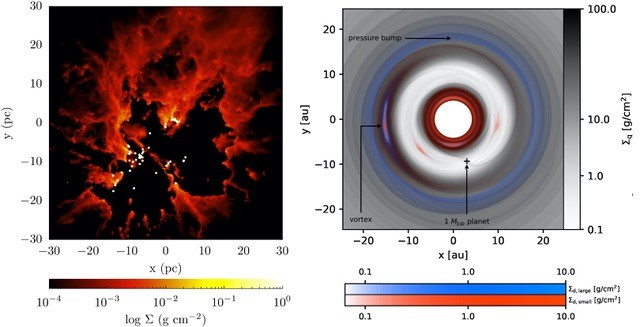
Left: Bubbles and pillars sculpted by HII regions in a turbulent molecular cloud. Snapshot of the neutral gas from a Smooth Particle Hydrodynamic simulation performed by Jim Dale. Right: A Jupiter mass planet interacting with the gas (gray scale) and dust of the accretion disk. Large particles (blue, >1mm) collect in a pressure maximum outside the planet orbit and also at the center of a vortex. Small dust grains (red, <10 micrometer) exist everywhere, but in this case are locally enhanced in the vortex center by collisional fragmentation of large particles.
LMU/USM Cosmology and Structure Formation
Within the Chair for Cosmology and Structure Formation at LMU, we are pursuing studies in cosmology and the formation and evolution of large scale structures in the Universe. Our work is at the interface of observation and theory, where we seek to bring together new observational constraints with state of the art hydrodynamical simulations of structure formation. In our recent papers we have presented forefront results in topics such as the nature of the cosmic acceleration, the sum of the neutrino masses, halo mass constraints from weak lensing studies of clusters, and the cosmic history of AGN feedback and its effects on the large scale structure. Most of our ongoing structure formation studies focus on clusters of galaxies, the most massive collapsed structures in the universe.
Our recent analyses have focused on galaxy cluster populations identified through the Sunyaev-Zel’dovich effect by the South Pole Telescope (SPT), optically selected clusters identified within the Dark Energy Survey (DES) and X-ray selected clusters identified through the ROSAT All Sky Survey. With the successful launch of eROSITA in summer 2019, our focus will now turn to the eROSITA cluster and group sample. We are also actively preparing for the ESA Euclid mission and for the LSST ground based survey, and we are participating in the scientific exploitation of radio data from the SKA precursor array MeerKAT.
In this IMPRS round, we will be searching for students to take a leading role in the following areas:
- Studies of the formation and evolution of galaxies and of the feedback history of radio AGN within and around X-ray, optically and SZE selected galaxy clusters using radio data from MeerKAT and SUMSS together with optical data from DES
- Studies of the growth rate of cosmic structures and of the cosmic acceleration using the evolution of galaxy cluster populations selected within the SPT-3G survey and eROSITA
LMU/USM Astrophysics, Cosmology, and Artificial Intelligence Group (no projects avalibale this application round!)
The overarching goal of our group is a model and a quantitative understanding of the cosmos as a whole and the structures that form inside of it. Our primary tool for this are photometric and spectroscopic cosmological surveys, which we use to study large structures in the Universe, such as galaxies, clusters of galaxies and even larger-scale matter density fluctuations. The census and evolution of these structures is interesting in its own right, but it can also give us a better understanding of two of the greatest mysteries of modern physics, dark matter and dark energy. To reach that goal, we need to develop new methods in statistics and data analysis, particularly artificial intelligence, for the extraction of reliable and powerful information from observations.
Our group consists of 15 researchers at all levels working on the calibration and innovative use of weak gravitational lensing measurements; the characterization of photometric and spectroscopic galaxy data, including with dedicated survey programs we lead; methods for modeling cosmological statistics of the matter and galaxy density field based on analytical calculations, simulations, and artificial intelligence; generative modeling of the galaxy and galaxy cluster population and their spectroscopic, photometric, and multi-wavelength observations; and the accurate and precise extraction of information from cosmological surveys with the help of artificial intelligence. We have relocated from Stanford University / SLAC National Accelerator Laboratory to LMU's University Observatory in 2021. We collaborate globally with observers, data scientists, and theorists from the Dark Energy Survey Collaboration, the Vera C. Rubin Legacy Survey of Space and Time, the Euclid project, the Dark Energy Spectroscopic Instrument collaboration, and 4MOST.
We invite applications from candidates with a strong track record of collaborative research in astrophysics, cosmology, and/or artificial intelligence. We are open to your own ideas that contribute to building a better model of the cosmos and connect to the existing work within our team
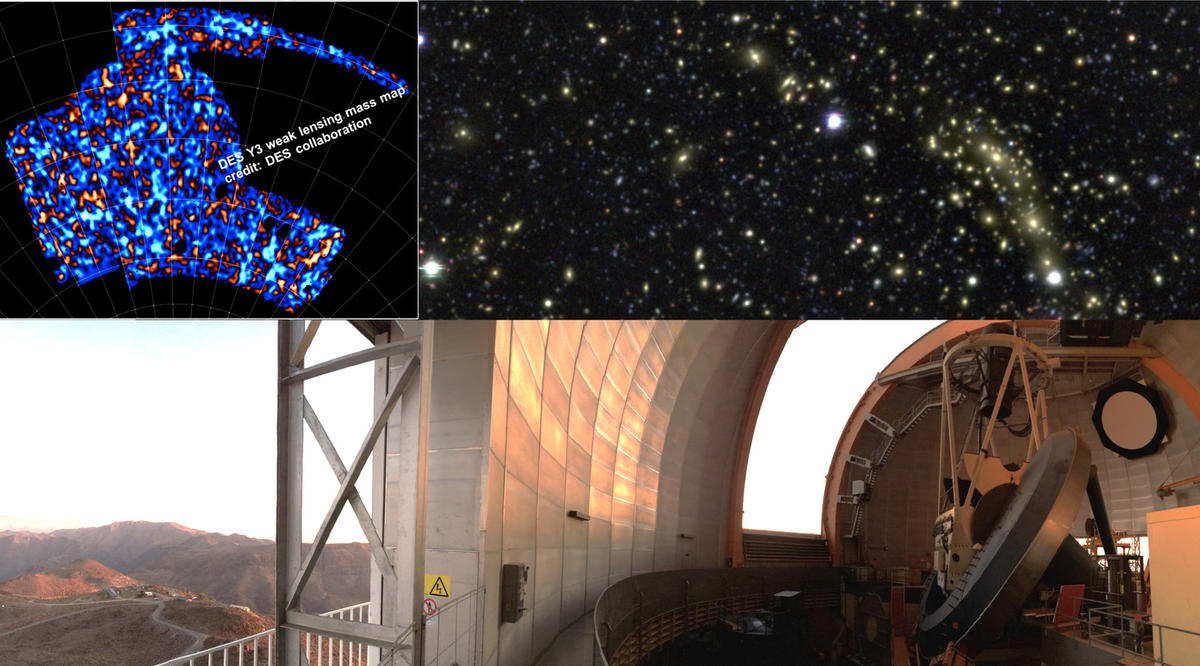
Top left: The largest map of matter density made with weak gravitational yet, from three years of Dark Energy Survey observations. Top right: Deep image of the galaxy cluster MACS J0416.1-2403. Bottom: The site of the future Vera C. Rubin Observatory as seen from within the dome of the Blanco Telescope on Cerro Tololo, Chile.
MPA Extragalactic Astrophysics and Cosmology
The MPA Cosmology group is interested in the structure, evolution and material content of our Universe. PhD positions can be offered in any (or a combination) of the following scientific topics which are currently under active study:
- The microwave background radiation as a probe of the origin of structure and the physics of the early Universe.
- Modeling and probing the intergalactic medium, with particular interest into simulations of reionization, radiative transfer and 21cm line observations.
- Modeling high-z galaxy formation and associated observables.
- The morphology, quantitative characterisation and observational measurement of the large scale structure in the galaxy, dark matter and intergalactic gas distributions.
- The use of gravitational lensing to constrain the nature of dark matter, the kinematic properties of high-redshift lensed galaxies and the presence of magnetic fields in lens galaxies.
- The structure, formation and evolution of galaxies and of their central supermassive black holes.
- The formation, fuelling and growth of supermassive black holes over cosmic time.
- The stellar populations of galaxies from the bulge to the outer halo.
- The structure and formation history of the Milky Way.
- The phenomenology of star formation in galaxies, of active galactic nuclei and of galaxy interactions, and its relation to the astrophysics driving the evolution of the galaxy population.
- The intergalactic and interstellar medium, its evolution and structure,
its chemical enrichment, its interaction with galaxies and AGN. - Using all of the above to test the current standard LCDM paradigm for the growth of cosmic structure, and to find tests for the nature of Dark matter and Dark Energy.
- Development of signal inference and image reconstruction methods based on information theory for galactic and extragalactic observations at various frequency bands ranging from radio to gamma rays.
Group members use a mixture of pure theory, high-performance numerical simulations, data interpretation, and direct observations to address these questions. The group is one of the principal nodes of the international Virgo Supercomputing Consortium which has carried out many of the largest cosmological simulations ever completed.
It is a Partner in the Sloan Digital Sky Survey IV and PhD projects are availabe to use integral field unit (IFU) spectroscopy of 10,000 nearby galaxies to study stellar populations, kinematics and gas and star-forming properties of galactic bulges, disks and halos.
The MPA is also involved in the the Prime Focus Spectrograph Galaxy Evolution Survey on the Subaru Telescope. This 130-night program will capitalize on the wide wavelength coverage and m assive multiplexing capabilities of PFS to study the evolution of typical galaxies from cosmic dawn to the present. From Lyman alpha emitters at z~7 to probe reionization, drop-outs at z~3 to map the inter-galactic medium in absorption, and a continuum-selected sample at z~1.5, this program will chart the physics of galaxy evolution within the evolving cosmic web.
With the MPA High Energy group it is the German centre for the Planck mission which is currently mapping the microwave background radiation. It has built a remote station for the radio interferometer Low Frequency Array.
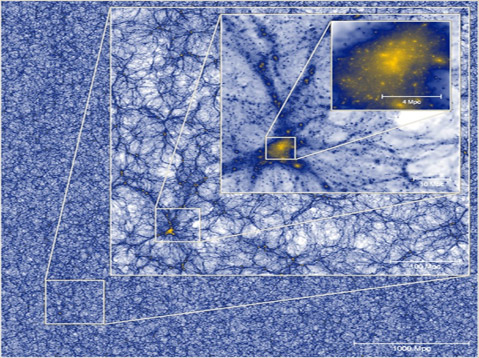
A slice through the dark matter distribution of the Millennium-XXL simulation, focusing on the most massive collapsed structure present a z=0. The Millennium-XXL, the largest simulation of cosmic structure formation ever carried out, follows the gravitational interaction of more than 300 billion dark matter particles on a cubical region of 4200 Mpc across. This calculation is used to study the very large-scale distribution of galaxies and its implications for Dark Energy measurements.
MPA High Energy Astrophysics
The area of interests of the MPA High Energy Astrophysics group can be broadly outlined as physical processes and interaction of matter and radiation under extreme astrophysical conditions. The objects where these processes are investigated include the Universe as a whole, clusters of galaxies, supermassive black holes and jets in AGN, accreting black holes and neutron stars in X-ray binaries, Gamma-ray bursts and the Cosmic Microwave Background. Similarities in the underlying physical processes bind these diverse subjects together. A special focus of the work is accretion onto compact objects (black holes, neutron stars and white dwarfs). This includes theories for the hydrodynamics of the accretion process and the origin of the energetic radiation. Examples are detailed theories for the boundary layer around accreting neutron stars, and the theory of Comptonization and it's applications. In addition members of the group are closely involved with interpretation of the observational signatures of accreting black holes and neutron stars, the study of X-ray emission from the clusters of galaxies, relic radio sources, theories for the central engines of Gamma-ray Bursts, the evolution of binary, triple, and higher-order multiplicity stars, and the behavior of magnetic fields in a wide range of astrophysical environments. Likewise, this research group has interests in the study of the interaction of CMB photons with matter at different evolutionary epochs of our universe. These include the cosmological recombination, the end of the Dark Ages/beginning of reionization, and the late accelerated expansion phase seeded by a cosmological constant or any sort of Dark Energy. Particular emphasis is paid on the characterization of the CMB spectrum generated during recombination, the interaction of the CMB with the heavy elements synthesized by the first stars, and the secondary anisotropies introduced by newly ionized bubbles, galaxy groups and clusters during the ntermediate and late ages of our universe. The group can host PhD students in any (or a combination of) these areas.
One of the key elements of the group's approach is to complement the theoretical advancement of the field with state-of-the-art data analysis of the experimental data. The group is actively using the data from the RXTE, CHANDRA, XMM-Newton, INTEGRAL, Swift and WMAP observatories. The group also provides scientific support for future missions that will lead to substantial progress in high resolution X-ray spectroscopy and microsecond timing.
Research fields for which PhD projects are offered:
- Physical cosmology: CMB, interaction of matter and radiation during
recombination, reionization and the late stages of our universe - Accretion onto black holes and neutron stars: theory and observations
- Jets in quasars and micro-quasars
- Elementary physical processes, including theory of Comptonisation
- Origin and growth of supermassive black holes
- Populations of accreting black holes and neutron stars in young and old galaxies
- X-ray emission from clusters of galaxies and cooling flows
- Models for central engines of Gamma-ray bursts
For more details visit the homepage MPA High Energy Astrophysics.
MPA Information Field Theory
Information field theory (IFT) is information theory, the logic of reasoning under uncertainty, applied to fields. A field can be any quantity defined over some space, e.g. the air temperature over Europe, the magnetic field strength in the Milky Way, or the matter density in the Universe. IFT describes how data and knowledge can be used to infer field properties. Mathematically it is a statistical field theory and exploits many of the tools developed for such. Practically, it is a framework for signal processing and image reconstruction.
The IFT research group at MPA
- develops the conceptual and mathematical framework of IFT
- derives generic and targeted imaging algorithms within IFT
- develops the computational tools required for IFT algorithms
- applies IFT to measurement problems in cosmology, high energy astrophysics, and other areas.
Research on IFT requires an excellent mathematical training and/or good programming skills. More information can be found at the IFT group page and the IFT resources pages.
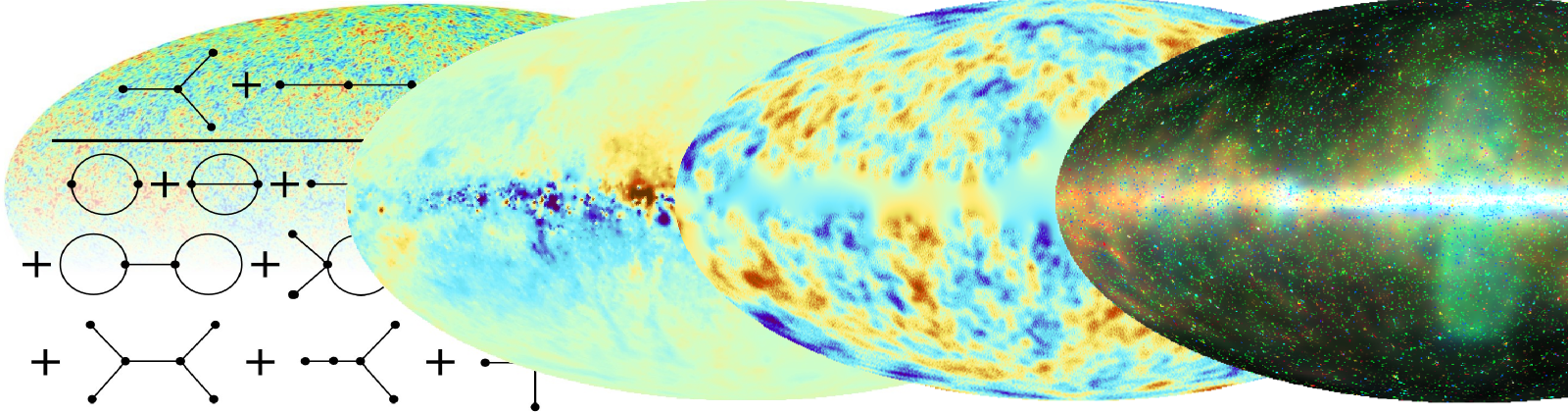
Examples of IFT applications. Leftmost: An estimator for primordial non-Gaussianity expressed in Feynman diagrams superimpose on an image of the cosmic microwave background (CMB). Middle-left: Reconstructed all-sky Faraday effect, showing the Galactic magnetic field. Middle-right: Reconstructed primordial gravitational potential at the location of the CMB last scattering surface. Rightmost: The gamma-ray sky reconstructed from data of the Fermi satellite in the energy range 0.5-300 GeV.
MPA Supernovae
The MPA Supernovae group is a world-leader in modelling the violent deaths of stars in the form of supernovae and studying how such explosions produce the chemical elements, generate gravitational waves or can be used as reliable cosmic distance indicators. Massive stars end their lives in core collapse supernovae when the star has run out of nuclear fuel in the interior. In some cases the explosion following the initial collapse can lead to particularly energetic hypernovae or gamma-ray bursts. Another type of supernovae occurs in binary systems involving white dwarfs, the compact remnants of less massive stars. These thermonuclear supernovae explosion can either be triggered by accretion of material from a companion star or during the merger of two white dwarfs. The MPA group specializes in performing realistic multi-dimensional hydrodynamical supercomputer simulations of the different types of supernovae and gamma-ray bursts, which takes into account detailed microphysics such as turbulent flame propagation, neutrino transfer, magnetic fields and special and general relativistic effects. The supernova models are also used to predict the emergent spectrum to compare with observations.
Most of the work within the group is theoretical/computational in nature but more recently the group has lead several observational programs aimed at understanding the physics of supernovae. The group has a long track-record of developing novel and sophisticated numerical methods to enable the extremely computing-intensive hydrodynamical simulations. The group has excellent access to powerful parallel supercomputers and is involved in the long-term Collaborative Research Center "Neutrinos and Dark Matter in Astro- and Particle Physics" (DFG). It also actively participates in the Excellence cluster on Origin and Structure of the Universe involving MPA, MPE, MPP, ESO, LMU and TUM.
Research fields for which PhD projects are offered:
- Explosion physics of thermonuclear supernovae
- Simulating gamma-ray bursts
- Neutrino transfer and core-collapse supernova
- Supernova nucleosynthesis
- Modelling and observations of supernova spectra
- Gravitational wave signature from supernova explosions
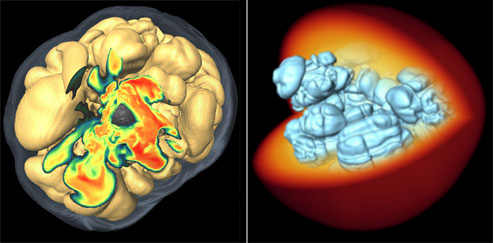
Left: A snapshot from a 3D simulation of a core collaps supernova,which demonstrates the complex hydrodynamical velocity field and neutrino heating during the earliest phases of the collapse prior to the final explosion. Right: A simulation of a thermonuclear supernova (SNe type Ia), which shows the 3D structure of the thermonuclear burning front in blue incinerating the white dwarf.
MPA Stellar Astrophysics
The MPA Stellar Astrophysics aims at understanding the physics of stars,
providing theoretical stellar models, and using stars as probes of the
cosmos,
for example for the evolution of galaxies.
An important aspect for this work is the study of the origin of the
elements -- when, where and how the different chemical elements were
produced in
the Universe. Essentially all elements have been forged by nuclear
reactions in
the fiery interiors of stars and MPA has for decades been a world-leader in
simulating stellar evolution and nucleosynthesis. Much of the work has
focussed
on understanding low- and intermediate mass stars and testing the models by
means of helio- and asteroseismology.
The stellar modelling within the group concentrates on understanding
better the
physics of stars, since only then nucleosynthesis, the ages of stars, their
masses, and in consequence even the evolution of galaxies can only be
deciphered
with confidence. The focus of our attention lies on improving the
treatment of
convection in stars of all masses and evolutionary stages, and to provide
accurate and reliable models for stars observed by asteroseismology
mission. We
are actively participating in the analysis and modelling of COROT and KEPLER
objects.
Research fields for which PhD projects are offered:
- Stellar evolution, mixing and nucleosynthesis
- Physics of stellar convection
- Probing stellar interiors through asteroseismology
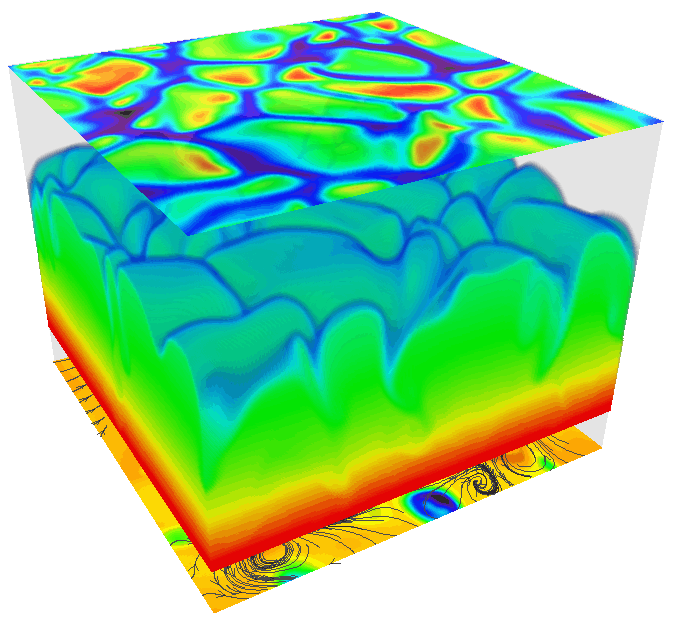
A small but representative volume of the stellar atmosphere is simulated by computing the convective and radiative energy transport. The 3D geometry of the atmospheric structure and the velocity field and their time-evolution can thereby be calculated and used to predict the emergent stellar spectrum.
MPA Multiphase Gas
The Universe is filled with multiphase gas, that is, different gas with extremely different temperatures is often found co-spatially within and around galaxies. Understanding its dynamics and observables is at the heart of our understanding how material flows in and out of galaxies to eventually form stars, planets and everything we see around us. Famous examples of multiphase gas are the interstellar medium (ISM), circumgalactic medium (CGM), galactic winds and the intracluster medium (ICM).
In the "Multiphase Gas" research group, we use theoretical and computational methods to understand these systems and how we can observe them.
In particularly, active research (in which we offer PhD projects) is being done in trying to answer:
- how does turbulence affect the evolution of multiphase gas and vice-versa?
- how do the different phases form, grow, or get destroyed?
- in what way does radiation propagate through a multiphase medium?
- how are the physical properties of multiphase gas imprinted on observable data?
- in which ways do multiphase gas flows affect galaxy evolution?
In the group, we develop new theories and write our own codes / numerical tools which we typically run on supercomputers.
For more information visit our webpage or reach out to our group members.
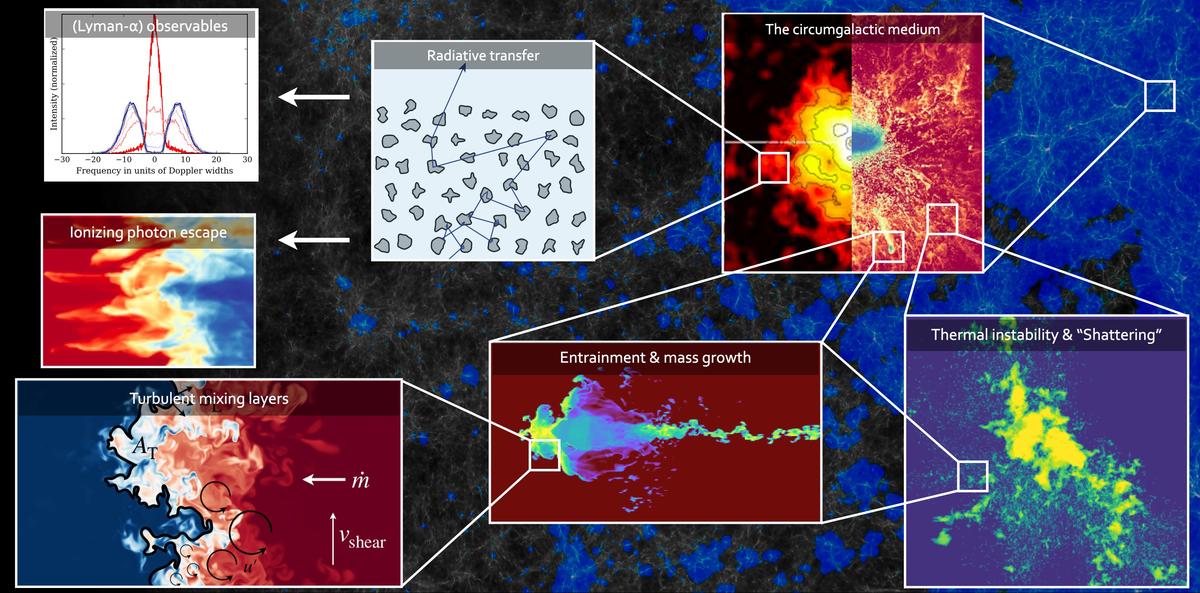
Overview of some of the research being conducted in MPA's Multiphase Gas Group. From top left: (1) Lyman-alpha spectra emergent from a clumpy, multiphase medium (adapted from Gronke et al. 2016, 2017), (2) path of Lyman alpha photon through a "very clumpy" (fc >> fccrit) medium (from Gronke et al. 2016), (3) observed Lyman alpha halo (from Arrigoni Battaia et al. 2019) and HI of a simulated galaxy (van de Voort et al. 2019), (4) HI fraction carved through the propagation of ionizing photons (from Kakiichi & Gronke 2021), (5) high resolution simulation of a turbulent mixing layer with the colors indicating temperature (from Tan et al. 2021), (6) cold gas being entrained in a hot wind (from Gronke & Oh 2018), (7) a cloud "shattering" due to rapid cooling (from Gronke & Oh 2020), (background) evolution of the ionized regions during the Epoch of Reionization (Ocvirk et al. 2020).
PhD Projects at ESO
The research activities at ESO focus on optical, infrared, and millimeter-wave astronomy, primarily using ground-based facilities at ESO observatories in Chile. In addition to optical and infrared imaging and spectroscopy, ESO astronomers are actively involved in developing and utilizing high-spatial resolution techniques such as adaptive optics and interferometry. Beyond these specific topics, the scientific expertise at ESO covers all major areas of astrophysics, including observational astronomy, modeling, and numerical simulations.
The research interests of ESO's science staff range from the Solar System to studies of the solar neighborhood (extrasolar planets, evolved stars, star formation), the interstellar medium, Galactic structure, galaxy evolution in the local Universe and at high redshift, the gas content of the Cosmic Web, and cosmology (galaxy clusters, Gamma-ray bursts, dark matter, lensing).
More details on science activities at ESO are available at ESO Science.
At ESO, we offer the following PhD topics for the IMPRS round starting in Fall 2025. Interested students must mention explicitly in their application the interest towards one (or more) of the listed topics:
- Galaxy evolution/formation:
- Planets' formation, exoplanets:
- Stellar evolution: neutron stars, explosion mechanisms and black holes:
More info about the IMPRS projects can be found here: IMPRS PhD at ESO
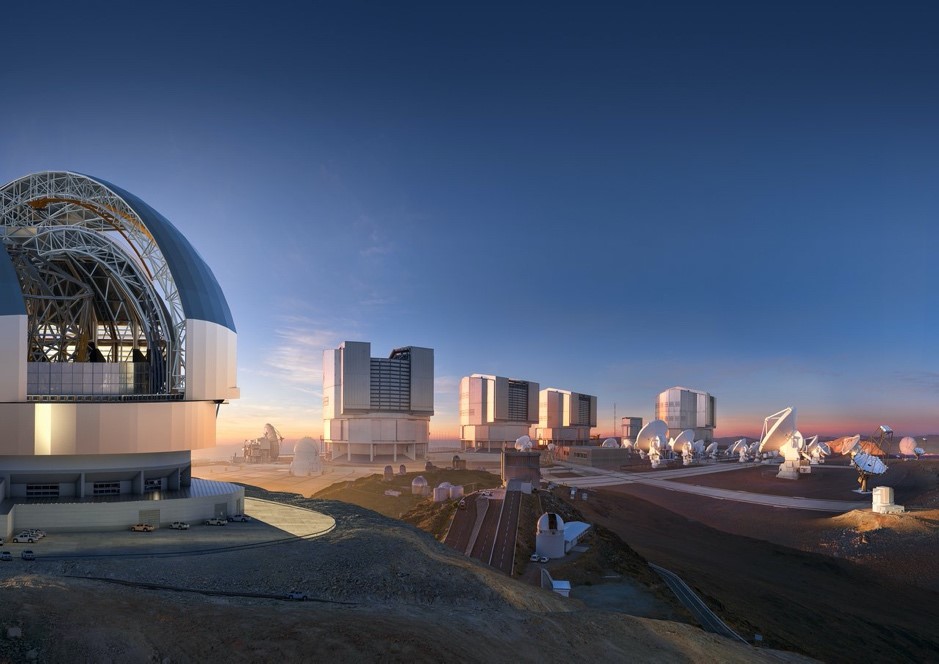
This collage shows ESO’s facilities in Chile from the La Silla and Paranal Observatories, merged into a single imaginary landscape. The forthcoming Extremely Large Telescope can be seen on the left, housing its giant 39-metre primary mirror; the 8.2-metre Unit Telescopes of ESO's Very Large Telescope are in the middle; and several of ALMA's 66 high precision antennas are on the right, along with antennas from the upcoming Cherenkov Telescope Array.